I. OpenClaw: How a Weekend Project Took Over GitHub
In November 2025, Austrian programmer Peter Steinberger (founder of PSPDFKit) started a weekend project called "Clawdbot." Four months later, it became OpenClaw and reached #1 on GitHub's all-time Stars leaderboard, surpassing both the Linux kernel and React.
📊 Key Metrics (as of March 2026)
- 248,711 Stars — #1 on GitHub all-time
- 34,168 new Stars in 48 hours — viral growth
- 47,700 Forks — highly active community
- 900+ contributors — thriving open source
- 13,729 community Skills — rich extension ecosystem
1.1 From "Chat Assistant" to "Action Agent"
OpenClaw's core idea is simple: upgrade LLMs from "chatting dialogs" to "digital employees that get things done." It gives AI the ability to:
- File system access — read/write local files
- Shell terminal control — execute system commands
- Browser automation — web operations and data scraping
- 24/7 daemon process — long-running, autonomous decisions
"From late 2025 to early 2026, AI experienced a paradigm-level shift. LLMs were no longer satisfied with conversation — they began demanding file system access, Shell terminals, browser control, and a long-running 'exoskeleton' for autonomous decision-making."
1.2 Four-Layer Architecture
| Layer | Name | Responsibility |
|---|---|---|
| L1 | Gateway | Session management, message routing, unified channel connection center |
| L2 | Channels | Communication layer supporting 20+ platforms including Discord, Slack, Telegram, WhatsApp |
| L3 | Agent Runtime | Core execution engine with multi-agent routing and isolation |
| L4 | Skills | Skill system for file operations, Shell commands, web automation |
1.3 Security Crisis & Lessons
In February 2026, security researchers discovered the ClawHavoc incident: 341 malicious Skills (11.3% of the marketplace) were stealing crypto keys and SSH credentials. This became the first large-scale supply chain attack warning for open-source AI Agent ecosystems.
On February 14, 2026, Sam Altman announced Peter Steinberger joined OpenAI to lead next-generation personal Agent development. OpenClaw was transferred to an open-source foundation to ensure community independence.
II. Agent Harness: The Engineering Core
If 2025 was the "Year of Agent," then 2026 is the "Year of Harness." A simple yet powerful formula is quickly becoming industry consensus:
🔧 Core Formula
Agent = Model + Harness
If you're not the model, what you're building is probably Harness. The model only provides reasoning and generation capabilities; Harness is the entire system beyond the model — system prompts, tool calling, file systems, sandbox environments, orchestration logic, feedback loops, constraint mechanisms.
2.1 Three Layers of Engineering
| Layer | Name | Problem Solved | Typical Work |
|---|---|---|---|
| L1 | Prompt Engineering | How to communicate instructions clearly | System prompt design, few-shot examples, chain-of-thought guidance |
| L2 | Context Engineering | What to show the Agent | Context management, RAG, memory injection, token optimization |
| L3 | Harness Engineering | How the system executes, corrects, observes, and recovers | File systems, sandbox, constraint execution, feedback loops, observation |
2.2 Six-Layer Architecture
| Layer | Name | Problem Solved |
|---|---|---|
| L1 | Information Boundary | What the Agent should/shouldn't know |
| L2 | Tool System | How the Agent interacts with the external world |
| L3 | Execution Orchestration | How multi-step tasks are chained together |
| L4 | Memory & State | How intermediate results in long tasks are managed |
| L5 | Evaluation & Observation | How the Agent knows if it did things right |
| L6 | Constraint, Verification & Recovery | What to do when things go wrong |
2.3 The 40% Context Threshold
Dex Horthy observed: With a 168K token context window, Agent output quality starts declining noticeably at around 40% usage. Anthropic calls this "context anxiety" — Sonnet 4.5 becomes hesitant when context is nearly full, even倾向于提前收工.
Solution: Context Resets — clear the context window but preserve key state through structured handoff documents. Treat 40% as an alert threshold; trigger compression, segmented execution, or task handoff when exceeded.
2.4 Real-World Team Data
📈 OpenAI Case: 3 People, 5 Months, 1M Lines, 0 Handwritten
- Team size: 3 engineers → later expanded to 7
- Code volume: ~1M lines, 0 lines handwritten (pure design constraints)
- PRs merged: ~1,500
- PRs per person per day: 3.5
- Efficiency gain: ~10x
Four Key Practices:
- Give Agent a map, not a thousand-page manual — AGENTS.md ~100 lines, acts as a directory; detailed rules loaded on demand
- Architectural constraints must be enforced by tools — "If it cannot be enforced mechanically, agents will deviate."
- Observability must be visible to Agent too — Chrome DevTools Protocol integrated into Agent runtime
- Entropy doesn't disappear on its own — background Agent periodically scans and auto-submits cleanup PRs
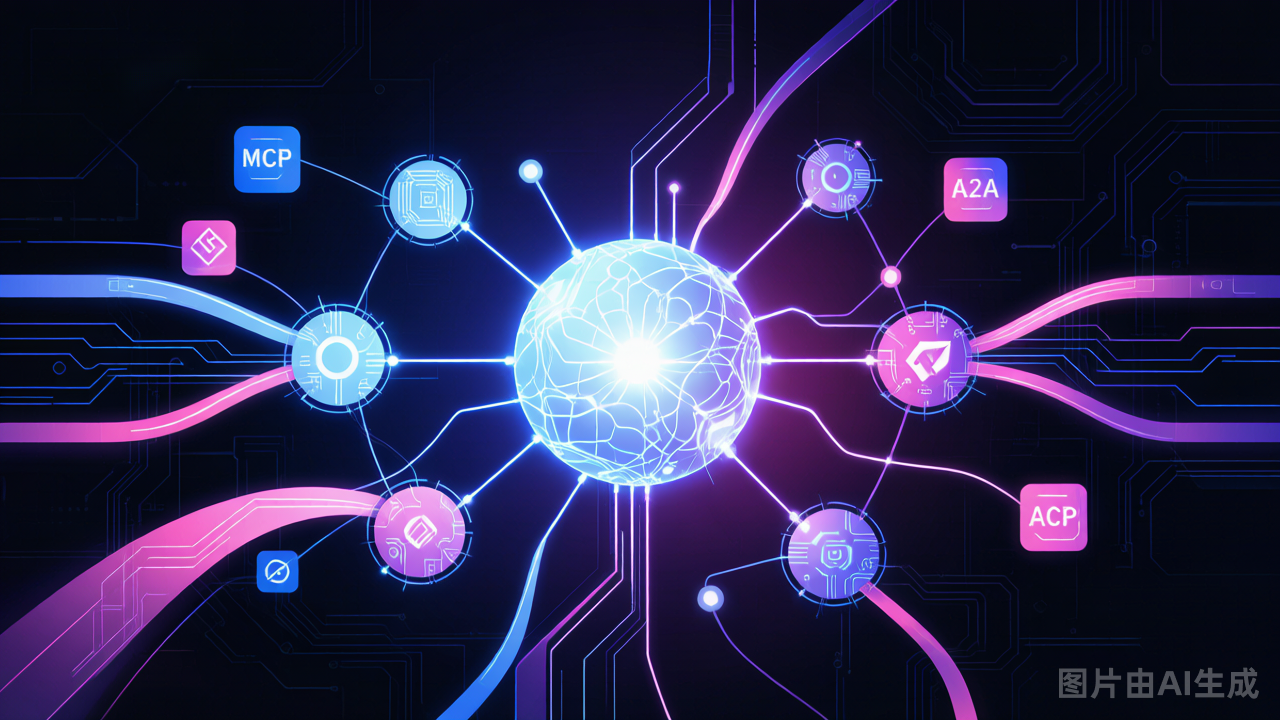
III. The Three Protocols: MCP, A2A, ACP
As enterprise AI systems evolve from isolated tools to collaborative agent networks, a key question emerges: How do different AI agents communicate and collaborate effectively? In 2025-2026, three protocols are shaping the AI Agent ecosystem.
3.1 MCP (Model Context Protocol)
Proposed by: Anthropic
Positioning: AI's "data and tool interface," similar to USB protocol for computers
Core problems MCP solves:
- Token explosion — on-demand loading, field filtering, pagination
- Inconsistent data formats — unified encapsulation for structured DB, semi-structured API, unstructured files
- Uncontrollable security and permissions — fine-grained permissions, audit logs, data desensitization
- High tool maintenance costs — hot-swappable tools, versioning, centralized management
3.2 A2A (Agent-to-Agent Protocol)
Proposed by: Google
Positioning: The "international language" for agents — cross-platform, cross-organization, cross-domain collaboration standard
Core components:
- Agent Card — each Agent's "ID + capability specification"
- Bidirectional communication interface — peer protocol where any Agent can be client or server
- Security and permission framework — based on OAuth2, API Key, scope authorization
3.3 ACP (Agent Communication Protocol)
Proposed by: BeeAI, IBM, and others
Positioning: The "walkie-talkie" for local real-time collaboration on edge devices
Core characteristics:
- Millisecond-level response latency
- Autonomous operation in weak/offline network conditions
- Fully decentralized, no central server
- Automatic device discovery and self-organizing networks
3.4 Comparison and Collaboration
| Dimension | MCP | A2A | ACP |
|---|---|---|---|
| Core Positioning | Model-tool/data connection | Cross-platform agent collaboration | Edge device local real-time collaboration |
| Deployment | Cloud-native, enterprise intranet | Global, cross-cloud, cross-organization | Edge, embedded, industrial sites |
| Latency | ~100ms | ~100ms to seconds | Millisecond-level |
| Decentralized | No | Supported | Yes |
| Typical Role | Data gateway, tool bus | Agent diplomacy, task chains | Device intercom, local networking |
Cloud-Edge-Device Standard Architecture:
- Cloud agents — A2A collaboration; MCP for internal systems
- Edge layer — ACP for local device collaboration; A2A for Edge-to-Cloud communication
- Global architecture — A2A for cross-domain + MCP for data access + ACP for real-time control
IV. AI Agent vs Agentic AI: Concept Clarification
A Cornell University research team clearly distinguished these two concepts in a comprehensive survey:
| Dimension | AI Agent | Agentic AI |
|---|---|---|
| Architecture Level | Single entity | Multi-agent network system |
| Goal Scope | Specific, well-defined single task | Complex, high-level overall goal |
| Intelligence Form | Individual intelligence (reactive) | System-level intelligence (collaborative) |
| Collaboration | Isolated operation, no collaboration | Multi-agent dynamic communication, shared memory, collaborative decisions |
| Typical Analogy | Single "employee" | Multiple "small teams" working together |
"Agentic AI is the natural extension of AI Agent. AI Agent is the building block of Agentic AI, and Agentic AI is the inevitable direction of AI Agent development."
V. Technology Evolution Roadmap
According to the Cornell survey and industry practice, AI Agent evolution can be divided into three stages:
Stage 1: AI Agent (Individual Capability Breakthrough)
- Proactive reasoning: from passive response → actively initiating tasks based on patterns/context
- Tool integration: dynamically accessing databases, APIs for complex tasks
- Causal reasoning: understanding cause-effect for diagnosis, planning, prediction
- Continuous learning: adjusting behavior through feedback and situational memory
Stage 2: Agentic AI (System-Level Collaborative Evolution)
- Multi-agent parallel collaboration: like human teams with coordination layer assigning roles
- Persistent memory architecture: ensuring long task coordination and state awareness
- Simulation planning: testing strategies, predicting outcomes, optimizing behavior before execution
- Ethical governance framework: ensuring accountability and value alignment
Stage 3: Next-Gen AI (AZR Paradigm)
- Autonomous generation, verification, and resolution of tasks → self-evolution (no external data needed)
- Propose hypothesis → simulate experiment → verify results → adjust strategy for automatic research
VI. Five Unsolved Core Problems
Despite the booming Agent ecosystem in 2026, these five problems remain unsolved:
| Problem | Current Status |
|---|---|
| Brownfield project transformation | Lack of mature methodology; public success cases are mostly greenfield projects |
| How to verify Agent did things right | Better at preventing wrongdoing than verifying correctness; "using AI-generated tests to verify AI-generated code" is like "checking your own homework with the same eyes" |
| Long-term maintainability of AI-generated code | LLMs often reimplement existing functions; long-term effects unclear |
| Should Harness be thick or thin | Manus rewrote five times, getting simpler each time; OpenAI's got more complex over five months — scenario-dependent |
| Single Agent or multi-Agent | Hashimoto insists on single Agent; Carlini used 16 parallel Agents — scale-dependent |
VII. Conclusion
In 2026, the AI Agent field is undergoing a critical transition from "proof of concept" to "production engineering." OpenClaw's viral explosion proved strong market demand for "action-oriented AI"; the rise of Harness Engineering signals the industry's focus on "how to make models perform stably in the right environment"; and the emergence of MCP/A2A/ACP protocols lays the foundation for interconnected Agent ecosystems.
"In 2026, the AI industry competition is no longer about 'whose Agent is smarter,' but about 'whose Harness is more complete.'"
For developers, there's no need to blindly pursue a "complete Harness Engineering system." Instead, start from the Information Boundary layer (L1) and Constraint/Recovery layer (L6) based on your business scenario, gradually building Agent infrastructure suitable for your team. After all, the core of Harness Engineering is not making the model stronger, but making the model perform stably in the right environment.